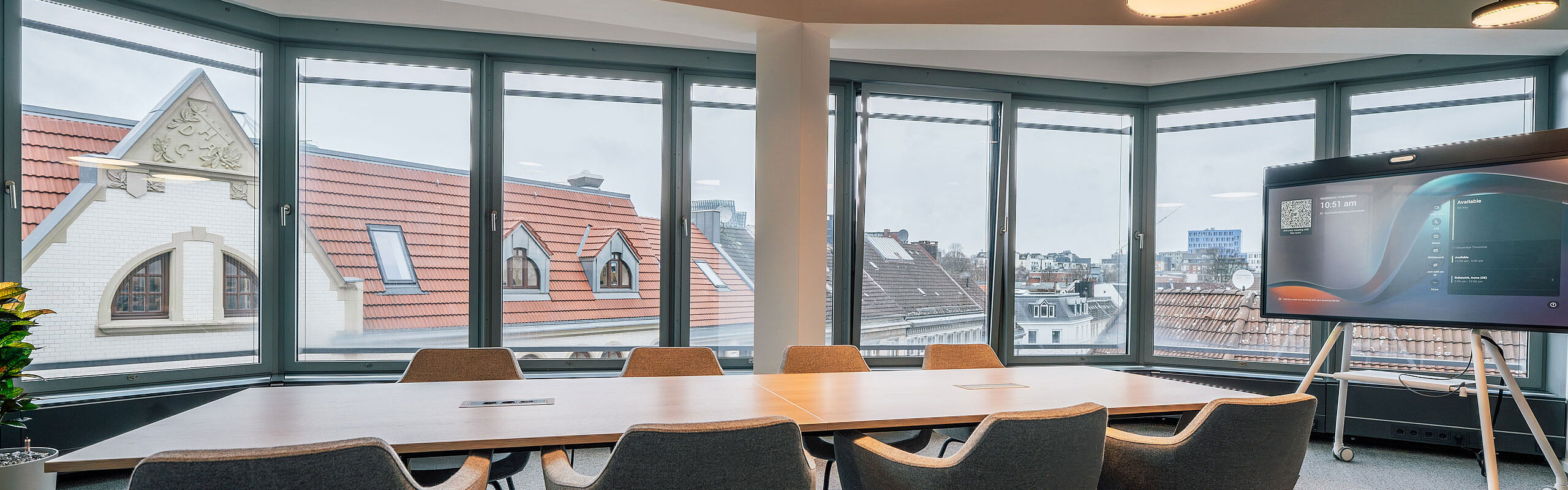
Real estate revitalization means developing existing buildings structurally, technically and functionally so that they once again meet the requirements of their users and the market. For office properties, it often combines a contemporary space concept with the renewal of fit-out and building services. The goal is a property that remains usable and economically viable in the long term.
Whether an office building is to become easier to let or a company wants to transform its working environment within an existing building: the starting point is the question of which qualities the property needs to offer in the future and which existing structures can be used to achieve them.
When does revitalization make sense?
Revitalization is an option when a building is in a suitable location but its spaces or technical equipment no longer meet demand. Typical triggers include:
- Vacancy or difficulty finding suitable tenants.
- Office space that does not adequately support focused work, exchange and hybrid collaboration.
- Outdated building services, high energy consumption or limited user comfort.
- Floor plans that are difficult to adapt to new teams, space requirements or rental units.
- A need for refurbishment that is to be combined with a new perspective for the entire building.
For owners and asset managers, lettability and long-term earning potential are often the priority. Companies need a working environment that reflects their processes and the needs of their employees. Bringing both perspectives together at an early stage allows investments to be planned in a more targeted way.
Whether the project is worthwhile depends in particular on location, building fabric, demand, structural feasibility and the ratio between effort and future benefit. A real estate analysis and consulting service supports this initial assessment.
Revitalization and related terms compared
The terms describe different focal points and can overlap within a project:
Refurbishment: Structural or technical defects are remedied. An energy-efficient refurbishment can also improve energy efficiency and the building standard at the same time.
Modernization: Fit-out, technology or structural properties are improved, for example through contemporary lighting or new technical systems.
Revitalization: Several measures are combined into one concept for the renewed usability and market position of the property. This includes user requirements as well as technical and economic questions.
Conversion: The type of use changes, for example from a residential building to an office building. A conversion can be part of a comprehensive redevelopment of existing buildings; revitalization is also possible without changing the type of use.
The gif (Society of Property Researchers, Germany) describes revitalization as adapting the quality and functionality of an existing property to changing user needs and classifies it as retaining the original use. A project should therefore clearly state whether the existing use is to be developed further or a different type of use is planned.
Which measures are part of revitalizing office buildings?
The scope of measures depends on the condition of the building and the future usage concept. In office properties, the following areas can work together:
- Space and floor plans: Reorganize rental areas and usage zones and create suitable spaces for meetings, collaboration and focused retreat.
- Building services: Align heating, ventilation, cooling, lighting and digital infrastructure with the intended use and clarify necessary renewals with the specialist planners.
- Energy performance: Examine suitable improvements to the building envelope and building systems to reduce energy demand during operation.
- Interior fit-out and furnishing: Combine acoustics, surfaces, furniture and wayfinding into a working environment that works.
- Safety and accessibility: Include fire protection, circulation and accessibility in the planning at an early stage.
- Preservation and reuse: Check which components, materials and furniture can continue to be used or adapted for a new use.
Coordinated office planning brings these requirements together. Construction work in existing buildings additionally requires clear responsibilities and coordination of the specialist planners and trades involved.
Revitalization can be divided into five interconnected steps. Depending on the building and the scope of the project, individual tasks may overlap.
- Assess the existing building: Record documents, building fabric, building services and current use. Check risks such as incomplete as-built plans, hidden damage or possible hazardous substances at an early stage.
- Clarify objectives and economic viability: Bring together the requirements of the owner, users and operations. Evaluate usage options, investments, expected benefits and time constraints.
- Plan the measures: Coordinate the space concept, technical solutions and fit-out. Specify the necessary permits, cost planning, construction phases and responsibilities.
- Manage the fit-out: Coordinate tendering, contract award and execution. Assess changes in the existing building and continuously monitor costs, deadlines and quality.
- Acceptance and commissioning: Inspect workmanship and functions, hand over the required documentation and prepare for the use of the new spaces.
If the building remains in use during the works, alternative spaces, safe routes, site logistics and possible interruptions to utilities or IT should already be part of early planning.
What influences the costs of revitalization?
The costs of revitalization result from the necessary interventions and the targeted standard. Particularly relevant are:
- Size, condition and technical equipment of the building.
- Scope of demolition, removal of hazardous substances and structural adjustments.
- Renewal of building services and energy-related measures.
- Requirements for interior fit-out, acoustics, materials and furniture.
- Planning, permits, site logistics and work during ongoing operations.
A reliable cost framework is based on an assessment of the existing building and clearly defined measures. When assessing economic viability, operating costs, possible downtime and long-term usability should be considered alongside the investment. Comparing options helps to evaluate the effort and impact of individual measures.
What role do sustainability and ESG play?
Preserving usable building fabric can reduce the need for new materials and the emissions associated with their production. Energy-related measures can also reduce energy consumption during operation. What matters is a view of the entire life cycle: Which resources are needed for the conversion, how will the building be operated afterwards and how long can it be used meaningfully?
A DGNB short study on the climate impact of refurbishments evaluated the life cycle assessments of 19 certified refurbishment projects. It shows the potential for lower building-related emissions compared to new construction and emphasizes that the appropriate optimization strategy must be examined individually for each building.
Accessible and highly usable spaces, durable materials and transparent documentation of measures and consumption data can also be relevant for ESG goals. Which goals a project actually achieves must be assessed on the basis of specific criteria and results.

Revitalization can offer economic advantages if suitable building fabric is retained. Whether it is cheaper depends, among other things, on technical adjustments, damage and the targeted standard. A comparison of options that takes both the investment and long-term operating costs into account is advisable.
The duration depends on the size of the building, the need for investigation, permits and the scope of measures. Delivery times and construction phases during ongoing operations also affect the schedule. A reliable schedule can be drawn up once the existing building, use and implementation have been clarified.
Sources and further information
- gif Society of Property Researchers, Germany, on the definition of revitalization (in German).
- German Federal Environmental Foundation (DBU) on the assessment and refurbishment planning of office buildings (in German).
- German Sustainable Building Council (DGNB) on the climate impact of refurbishments (in German).
- German Environment Agency (UBA) on resource-efficient construction in existing buildings (in German).