Technical Rules for Workplaces (ASR)
German Workplace Ordinance (ArbStättV)
Ensuring the safety of users and the proper fit-out of your property is essential. The German Workplace Ordinance (ArbStättV) sets out detailed requirements for the design and operation of workplaces.
It provides binding specifications for, among other things, circulation routes, escape and emergency routes, storage areas, plant and machine rooms, welfare facilities, break rooms, first-aid rooms and accommodation areas. The objective of the ArbStättV is to protect employees in workplaces and to prevent occupational accidents and work-related illnesses. This includes, for example, fall accidents caused by defective floors or staircases, transport accidents resulting from unsuitable or insufficiently dimensioned circulation routes, serious injuries caused by the shattering of glass partitions, or health impairments due to excessive noise levels.
In addition, the ArbStättV defines requirements for air quality, thermal comfort and lighting conditions, and sets standards for appropriate welfare facilities, in particular sanitary and rest areas.
Technical Rules for Workplaces (ASR)
The Technical Rules for Workplaces (ASR) specify and clarify the requirements of the German Workplace Ordinance (ArbStättV). They replaced the former workplace guidelines issued under the Workplace Ordinance of 1975. However, the ASR themselves also became invalid at the beginning of 2013.
Nevertheless, the provisions of these two obsolete workplace guidelines continue to serve as reference values when designing and operating workplaces. Deviations from the guidelines are only permitted if the employer implements alternative measures that are equally effective and achieve the same level of protection as defined by the ASR.
There are currently 22 Technical Rules for Workplaces:
ASR V3 Risk assessment
ASR V3a.2 Barrier-free design of workplaces
ASR A1.2 Room dimensions and movement areas
ASR A1.3 Safety and health protection signage
ASR A1.5/1,2 Floors
ASR A1.6 Windows, skylights and translucent walls
ASR A1.7 Doors and gates
ASR A1.8 Traffic routes
ASR A2.1 Protection against falls and falling objects; access to hazardous areas
ASR A2.2 Measures to prevent fires
ASR A2.3 Escape routes and emergency exits; escape and rescue plans
ASR A3.4 Lighting
ASR A3.4/3 Emergency lighting and optical safety guidance systems
ASR A3.5 Room temperature
ASR A3.6 Ventilation
ASR A3.7 Noise
ASR A4.1 Sanitary facilities
ASR A4.2 Break rooms and rest areas
ASR A4.3 First-aid rooms, equipment and facilities
ASR A4.4 Accommodation
ASR A5.1 Workplaces not fully enclosed and outdoor workplaces
ASR A5.2 Requirements for workplaces and traffic routes on construction sites in areas adjacent to road traffic – road construction sites
ASR A6 Display screen work
Workplace Ordinance for offices
Within an office environment, employees are not exposed to hazardous materials or machinery. Nevertheless, occupational health and safety regulations also apply to office work. Here, we provide a collection of all relevant office-specific requirements.

Lighting regulations
As a basic principle, workspaces must have sufficient natural daylight. For this reason, the window area must amount to at least 10% of the room size. If natural lighting is not sufficient, additional artificial lighting must be provided. In this case, the illuminance should be at least 500 lux. Using standard office lighting in combination with an individually adjustable desk lamp, employers can easily meet these requirements.

Maximum permissible noise exposure
Especially for mentally demanding work, which is predominantly carried out in offices, the noise level in the workplace should be kept low. As a general rule, the noise level for typical office activities must not exceed 65 dB(A). For cognitively demanding tasks, the Workplace Ordinance specifies a limit of 50 dB(A). For comparison: the sound level of rainfall or a refrigerator is around 50 decibels, while a conversation at normal volume is approximately 55 decibels.
Regulations on room dimensions
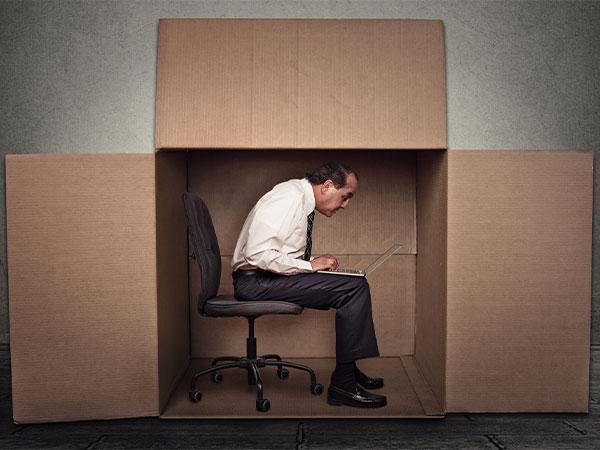
When planning and furnishing an office space, various areas must be taken into account: space for furniture, user areas at desks, in front of storage units or copiers, circulation routes, and movement areas for using office chairs. Unobstructed movement along routes to workstations, storage units, doors and windows is just as important as sufficient space at the desk and the ability to change working postures.

Office room temperature
The Workplace Ordinance sets out clear requirements for room temperature in office environments. For office work, the temperature must be at least 19°C and must not exceed 25°C. Due to extreme weather conditions, the office temperature may occasionally fall below or rise above this range. In such cases, the employer is required to take action. There are various measures that the employer is legally obliged to implement.

Ergonomic requirements for an office workstation
Office workstations must be designed ergonomically. This applies to both technical equipment and furniture. In addition, employers are required to instruct their employees in the correct ergonomic use of equipment. Another important aspect in this context is the minimum room size required per workstation. Current workplace guidelines specify that a display screen workstation must provide a minimum floor area of eight square metres.
Conclusion: Office-specific requirements of the Workplace Ordinance
In offices, a number of aspects must be observed with regard to the Workplace Ordinance and workplace guidelines. Below is a summary of the most important values at a glance:
Office floor area: 8 m² (plus at least 5 m² for each additional employee)
Window area: 10% of the room area
Illuminance at office workstations: 500 lux
Noise level: <65 dB(A) or 50 dB(A)
Room temperature: 19–25°C
A labour inspector monitors compliance with these reference values in the workplace. If deficiencies are identified, an improvement notice is issued first and guidance is provided. If no improvements are made thereafter, the labour inspector may file a report with the local administrative authority.