
General Contractor in Construction: Definition and Responsibilities
When a general contractor makes sense – and how it differs from a general planner-contractor
A general contractor takes overall responsibility for the delivery of a construction project – coordinating all trades and managing the execution from planning through to completion. For clients, this means a single point of contact, clear processes and reduced coordination effort.
But what exactly does a general contractor do? Which responsibilities do they take on, and how do they differ from a general planner-contractor? In this article, we explain the role, outline the key responsibilities and provide a practical comparison of both delivery models.
What Is a General Contractor? Definition and Key Responsibilities
The definition of a general contractor describes a central contractual partner in construction who takes responsibility for the complete delivery of a project and coordinates all involved trades.
A general contractor (GC) ensures that a planning concept is translated into a functional, usable space. They organise the execution, manage workflows and take responsibility for how all project parties work together.
The question “What is a general contractor?” can therefore be answered as follows: A general contractor brings planning results into execution and ensures that a construction project is delivered within the defined time, cost and quality framework.
What matters most is not the individual service, but how well all services interconnect.
General Contractor in Construction: Responsibilities and Role Within a Project
In the context of a general contractor in construction, it quickly becomes clear that the real challenge rarely lies in the individual trades themselves, but in how they are coordinated.
The core responsibilities of a general contractor are to connect and align all construction processes. This includes coordinating the trades, managing schedules, ensuring quality and maintaining ongoing alignment between all project stakeholders.
A general contractor translates planning into execution. They make sure that dependencies work, decisions are made at the right time and workflows do not come to a standstill. This is where their central role within the project lies.
Benefits of a General Contractor: Structure Instead of Interfaces
The benefits of a general contractor become particularly clear when projects increase in complexity.
Instead of coordinating many individual trades separately, responsibility is bundled within one central role. This reduces interfaces and creates clarity in communication. For clients, this means less coordination effort and greater control over the overall project.
At the same time, workflows become more reliable. The fewer handovers required between different parties, the lower the risk of delays or misunderstandings.
In practice, good projects are not created through more management, but through clearly defined responsibilities.

Difference between a General Contractor and a General Planner-Contractor
The difference between a general contractor and a general planner-contractor essentially comes down to where responsibility for planning lies.
A general contractor delivers a project based on an existing planning framework. This may be provided by the client, architects or external planners.
A general planner-contractor, on the other hand, also takes responsibility for the planning and integrates it directly into the project delivery process.
The difference between a GC and a GPC is therefore not only about the scope of services, but also about how flexibly the project can respond to changes.
General Contractor Definition
The definition of a general planner-contractor describes a model in which planning and execution are fully integrated within one contractual responsibility.
For clients, this provides a high level of relief, as they have a single point of contact for the entire project.
General Contractor for Renovation Projects: Navigating Complexity in Existing Buildings
A general contractor for renovation projects faces different requirements than a new-build project.
In existing buildings, planning and reality often meet more directly. Existing structures, technical constraints or ongoing use can make projects less predictable. This is where the value of a general contractor becomes particularly clear.
Through centralised project coordination, adjustments can be integrated more quickly and workflows can be stabilised. Decisions do not have to pass through multiple interfaces, but can be made in a targeted and coordinated way.
What matters is not avoiding uncertainty altogether, but managing it in a structured way.
Interior Fit-Out as General Contractor: Translating Use into Space
Interior fit-out as a general contractor is a typical field of application for general contractors, particularly in the context of modern workplace environments.
This is not only about construction, but about use. Different trades have to be brought together in a way that results in functional spaces.
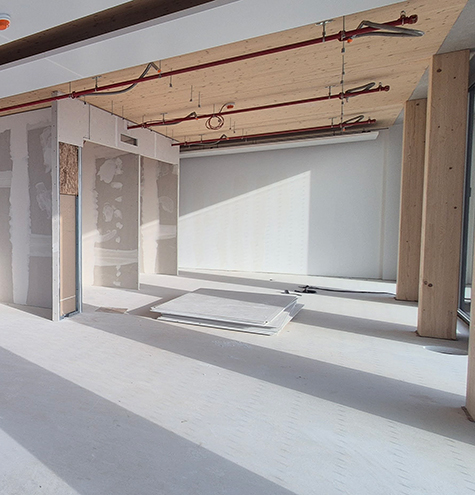
These include drywall construction, floor and ceiling systems, as well as technical trades such as electrical installations, lighting and climate control. A general contractor ensures that these elements are not delivered in isolation, but work together as an integrated system.
In practice, the quality of a space is not defined by individual components, but by how well they interact.
Fit-Out General Contractor: Holistic Delivery of Spaces
A fit-out general contractor takes responsibility for the complete fit-out of a space and ensures that all measures are delivered in a coordinated way.
The advantage lies in the holistic approach. Instead of separate trades working in isolation, a consistent solution is created in which workflows, technical requirements and use are considered together.
This is particularly important for commercial spaces, where multiple requirements need to be met at the same time.

When Does a General Contractor Make Sense?
The question “When does a general contractor make sense?” is best answered by looking at the complexity of the project.
A general contractor is particularly valuable when several trades need to be coordinated, workflows have to interconnect and a clear structure is required. This applies especially to projects in the fields of general contractor construction, interior fit-out as a general contractor or renovation projects delivered by a general contractor.
The model offers clear advantages whenever a project needs to be managed efficiently.
- one point of contact for all trades
- reduced interfaces
- clear responsibilities
- more efficient project management

Budget and Costs: The Role of a General Contractor in Construction
The role of a general contractor in construction also becomes clear from an economic perspective.
A general contractor allows for flexible project control, as planning and execution can be considered separately. This makes it easier to integrate adjustments in a targeted way throughout the project.
With a general planner-contractor, on the other hand, the focus is often on a fixed price. This provides cost certainty, but can also reduce flexibility when changes arise.
What matters, therefore, is not only the cost structure, but how dynamically the project can respond to change. In practice, this always depends on the specific company commissioned and the contractual framework agreed.
Successful Project Delivery with a General Contractor
A general contractor, simply explained, is the partner who ensures that a construction project is not only planned, but delivered in a way that works in practice.
The difference between a general contractor and a general planner-contractor mainly lies in whether planning is part of the contracted scope or not.
Especially in commercial fit-out projects, it becomes clear again and again how crucial the careful coordination of trades is to project success. Ultimately, it is not the delivery model itself that determines the success of a project, but how clearly roles, responsibilities and workflows are defined.
Frequently Asked Questions About General Contractors:
Questions about general contractors often arise in practice – from their specific role within a project to how they differ from other delivery models. The following questions and answers provide a concise overview of the most important aspects of working with a general contractor and help put them into a practical context.
A general contractor takes responsibility for the complete delivery of a construction project and coordinates all involved trades.
Coordination, site management, schedule and cost control, as well as quality assurance.
A general contractor is responsible for delivering a project based on an existing planning framework, while a general planner-contractor also takes responsibility for the planning phase.
For complex projects involving multiple trades and a high level of coordination.
Are you interested in fitting out your office?
At coneon, we offer the complete service package – from the first idea through to the finished workplace.
Together with you, we develop your new office space and deliver it in a structured, efficient way, with a clear focus on quality.