General Contractor: Design and fit-out of modern offices
coneon as a General Contractor with In-House Planning Department
As a general contractor in Germany, coneon manages the entire execution of your office construction project – from initial planning through to turnkey handover. For you, this means a centrally managed project, clear processes, and all services delivered from a single source.
We support your project from the initial concept through the design and installation of floors, walls, and ceilings, including electrical systems, lighting, and climate control. In doing so, we take on all key responsibilities of a general contractor in construction: coordinating, supervising, and managing all trades involved in the building process.
With our in-house planning department, we combine architecture, project management, and execution into a holistic approach – efficient, structured, and focused on creating functional work environments.
What is a General Contractor? Definition Explained Simply
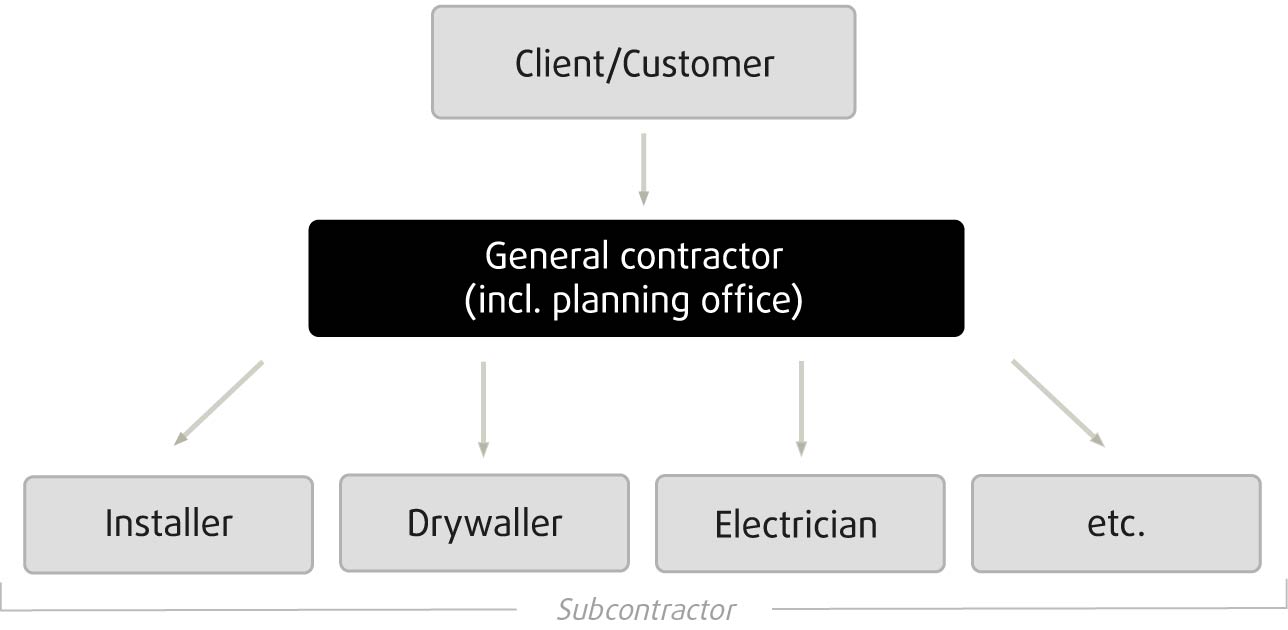
The definition of a general contractor is relatively straightforward: a general contractor is responsible for the planning, organization, and management of a construction project, while the actual construction work is carried out by specialized subcontractors.
If you are wondering, what does a general contractor mean in office fit-outs?
It means you have a single point of contact who manages your entire project, without you needing to coordinate individual trades.
General Contractor: A Single Point of Contact
One of the key advantages of working with a general contractor is clear and structured communication. At coneon, you have one dedicated contact person throughout the entire interior construction process.
You do not need to select or coordinate individual companies. Instead, we rely on our established network of experienced manufacturers, suppliers, and tradespeople. This ensures that we work exclusively with partners whose quality and reliability we know from long-term collaboration.
Coordinating all involved trades is one of the core general contractor responsibilities and is essential for ensuring a smooth construction process.
On-Time Delivery Through Structured Planning
Time management plays a crucial role in any construction project with a general contractor. Thanks to our expertise in construction scheduling, we ensure that all work is completed on time and efficiently.
We create a detailed project schedule that covers all phases of the project. Based on this plan, contractors, suppliers, and installers work in close coordination. A clearly defined completion date provides additional security and ensures that your new office space is ready on time.
Cost Planning and Budget Control
One of the major advantages of working with a general contractor is transparent cost management. We operate with cost efficiency in mind and aim to deliver the best possible solution within your budget.
Through our integrated planning approach, we maintain full control over costs at all times. Even during the planning phase, we identify potential savings without compromising on quality or design.
Throughout the construction phase, continuous cost monitoring is carried out by the project manager. This often allows us to offer fixed-price solutions and ensures maximum financial certainty.
What Does a General Contractor Cost?
The question “How much does a general contractor cost?” depends on several factors, including project size, level of fit-out, and technical requirements.
Since each project is unique, costs cannot be defined as a fixed amount. To provide guidance, we offer a comprehensive cost guide with benchmarks for interior construction, planning, and furnishing.
Compliance with Building Regulations and Safety Standards
Ensuring compliance with all building regulations is a key part of a general contractor’s responsibilities in construction. During the planning phase, all structural modifications are carefully reviewed, statically assessed, and approved.
Special attention is given to fire protection, safety systems, and legal building requirements. This ensures that your project is not only functional and cost-effective but also fully compliant with all regulations.
No Disruptions: Construction in Occupied Spaces
One of the major advantages of working with coneon as a general contractor is our expertise in working within existing buildings.
We ensure that your business operations can continue during the construction phase. Upon request, we handle relocation management, interim storage, and temporary solutions.
This minimizes disruptions and allows you to stay focused on your core business.
General Contractor vs. General Builder – What’s the Difference?
The difference between a general contractor and a general builder (general contractor vs. general contractor model) lies primarily in how construction work is carried out.
A general builder often performs construction work using their own workforce. A general contractor, on the other hand, manages the entire project and assigns individual tasks to specialized subcontractors.
This approach offers key advantages: greater flexibility, access to specialized expertise, and centralized project management. Especially for complex projects such as office fit-outs, this model is highly efficient.
General Contractor Companies – Why coneon?
When searching for general contractor companies, it is not just about construction work itself, but about the quality of project management.
coneon combines planning, coordination, and execution with a clear focus on modern work environments. Our approach goes beyond traditional interior construction: we design spaces based on actual usage and develop solutions that work in the long term.
Office Fit-Out – What Interior Office Construction Includes
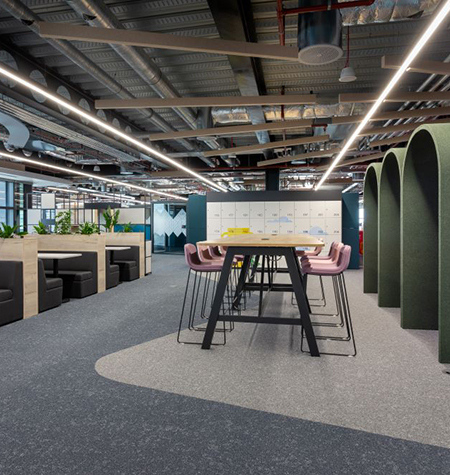
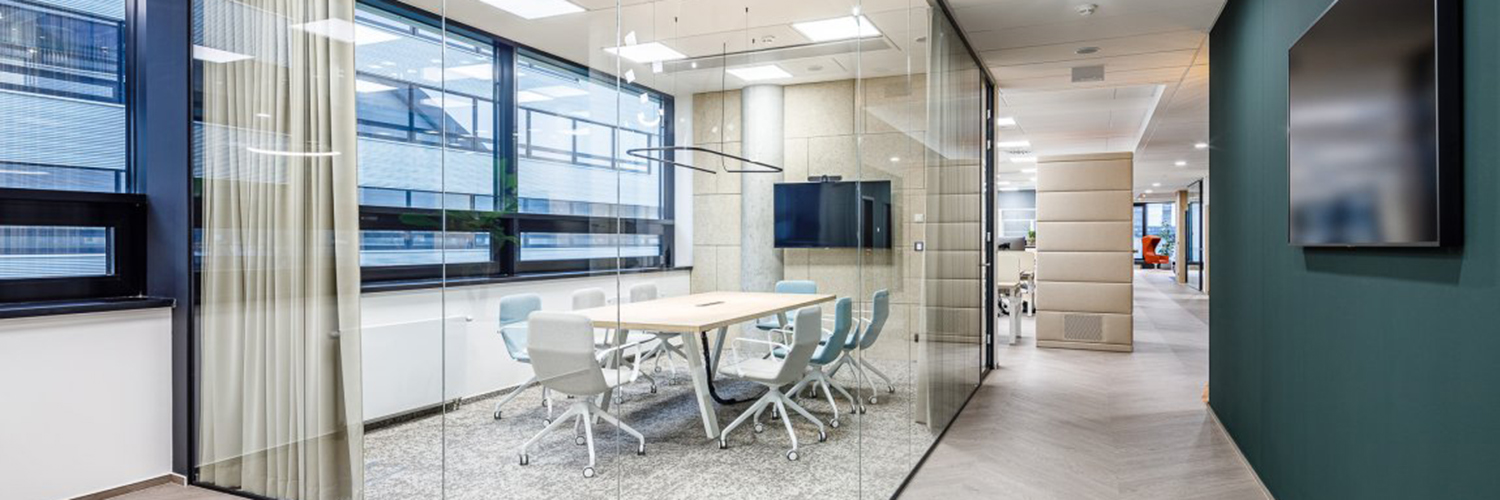
Office interior construction includes a wide range of services, all coordinated by us as a general contractor. This covers structural work on floors, walls, and ceilings, as well as the integration of modern lighting, climate, and electrical systems.
In addition, areas such as acoustics, media technology, IT and network infrastructure, as well as security and sanitary solutions play a central role. This is complemented by the design and furnishing of office spaces – from traditional workstations to conference rooms, social areas, and creative collaboration spaces.
The goal is to create a work environment that is functional, efficient, and tailored to your company’s actual needs.
Frequently Asked Questions About General Contractors
In practice, working with a general contractor often raises specific questions – ranging from the precise definition of their roles and responsibilities to costs and how they differ from a main contractor. Particularly with complex projects such as office fit-outs, there is often uncertainty as to which model is the right one and what advantages it offers. The following questions and answers provide a concise overview of the key aspects relating to the general contractor and help to put these into a practical context.
A general contractor is responsible for planning, managing, and coordinating a construction project. The actual construction work is carried out by specialized subcontractors. For clients, this means having a single point of contact and an efficiently managed project.
The main responsibilities of a general contractor include planning, coordinating, and supervising all trades involved in construction. This also includes scheduling, cost control, quality assurance, and ensuring compliance with all building regulations.
The difference between a general contractor and a general builder lies in how construction work is executed. A general builder typically carries out the work themselves, while a general contractor assigns it to subcontractors and manages the overall project.
The cost of a general contractor depends on factors such as project size, level of specification, and technical complexity. A general estimate is not possible, but structured planning and transparent costing often lead to greater financial certainty.
A general contractor is particularly beneficial for complex projects such as office fit-outs. Centralized coordination increases efficiency, reduces coordination effort, and minimizes potential errors.
A general contractor in office fit-outs offers the advantage of delivering all services from a single source. This reduces coordination effort, saves time, and ensures clear responsibility throughout the project.
Interested in an Office Fit-Out?
As a general contractor for office fit-outs, coneon offers a complete service package – from the initial idea to the finished workspace.
Together with you, we develop your new office environment and implement it in a structured, efficient manner with a strong focus on quality.