Workplace guidelines on volume and office noise
What regulations exist regarding noise and volume in the office and workplace? What does occupational safety for noise look like and what can be done about noise in the office?
Noise and loud sounds are omnipresent in many offices and can hinder concentration and, in the worst case, even lead to health risks and damage. Conversations at neighbouring workstations, office equipment, air conditioning systems and colleagues on the phone: all of these can produce disturbing noises. Various noise protection measures at the workplace by employers and employees can help to reduce unpleasant noise.
Measurement of noise in the workplace
Everyday office life is characterised by phone calls, meetings and spontaneous exchanges, but also by concentrated individual work. Ideally, both communication and concentration should be possible without interference. However, if the noise level caused by conversations and technology is too high in the long term, this can become a stress factor and pose a significant health risk in the long run.
There are various parameters for measuring noise in the workplace:
- Sound pressure level:
The sound pressure level indicates the effect of sound on humans (sound immission) and is used to describe the volume. The pressure of the sound waves depends on the distance from the sound source. - Decibel = dB or dB (A):
Decibel is the logarithmic unit of measurement for sound pressure level. The A-weighting of the measured sound pressure level takes into account the human hearing curve. Humans hear differently depending on the frequency, so low tones are perceived as louder than high tones. - Sound power level:
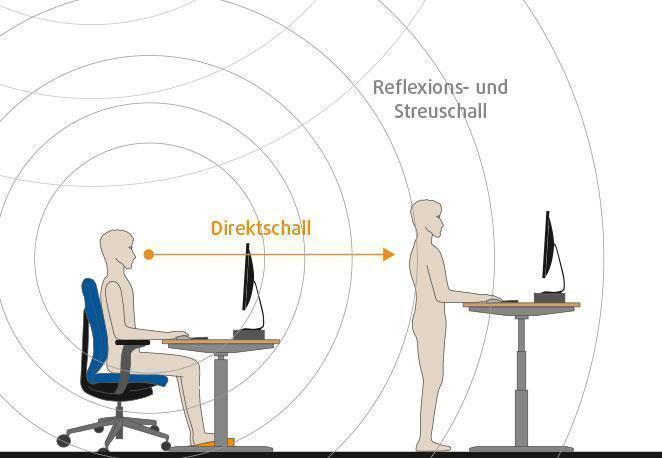
The sound power level indicates the strength of the sound source (sound emission) and is decisive for comparing the noise of devices and machines, such as printers. - Spatial decay rate of speech D2,S:
The sound level decreases with increasing distance from a sound source. The architecture of the room (room shape, furniture, surface texture, etc.) influences the rate at which the sound level decreases over distance in the room. The higher the spatial decay rate, the less noise is perceived in the more distant areas of an open-plan office. - Reverberation time T:
Reverberation time is the period between the source being switched off and the sound energy density decreasing by 60 dB. This characterises the ‘reverberation’ of a room. For a pleasant noise level, this should be as low as possible. - Average sound pressure level – assessment level:
The assessment level measures noise pollution at workplaces by measuring the sound pressure level over a certain period of activity. This serves as a limit value or guideline.
Average level for workplace design
There are guidelines for workplace design with regard to disruptive office noise. According to Workplace Ordinance Appendix No. 3.7 (partially supplemented by the Technical Rules for Workplaces, ASR), a sound pressure level of 40 dB (A) to 45 dB (A) is considered suitable for predominantly intellectual activities such as concentrated work at an office workplace. This should always be as low as possible in order to minimise psychological stress and health impairments.
Questions about office planning or workplace regulations?
When designing workplaces or workspaces, the following average levels for different activities can be used as guidelines:
A sound pressure level of 40–45 dB(A) is recommended for intellectual activities. For comparison – how loud is 40 dB? – this corresponds approximately to a quiet conversation or the humming of a refrigerator.
- 35 to 40 dB(A): for tasks requiring a high level of concentration, such as demanding administrative work, programming or scientific work
- 35 to 45 dB(A): for concentrated, predominantly mental work
- 40 to 45 dB(A): for tasks requiring communication with customers and very good speech comprehension
- 40 to 50 dB (A): in call centres and for screen work in a commercial environment
- 45 to 55 dB (A): for routine office work
- maximum 55 dB (A): for predominantly intellectual activities involving decision-making and problem-solving tasks, complexity or requirements for good speech intelligibility
Assessment of noise stress in the office
An assessment level of 55 dB(A) can already be considered borderline. If the level rises briefly to 58 dB(A), the exposure limit is reached after four hours, and at 61 dB(A) after only two hours. However, the daily average does not take into account peak loads or brief periods of loud noise.
Furthermore, the type of sound is not insignificant when assessing the annoyance of noise. High-pitched and shrill sounds are perceived as more unpleasant than low-pitched sounds. Conversations and unpredictable noise are the most disruptive, whereas steady noise is better tolerated. In addition to noise within the office, noise can also penetrate a workplace through walls, ceilings or windows. It is also important to take into account the personal circumstances of employees and interactions with other stress factors.
It should be noted that the assessment level for evaluating noise stress in the office is only of limited significance. Even below this guideline value, noises can be perceived as very unpleasant. Therefore, when planning an office that is as quiet as possible, employers must take into account the individual work tasks and their specific requirements. It can be helpful here to include employees' statements about the disruptive and stressful effects. Finally, possible vibrations must also be taken into account, as specified in the Noise and Vibration Occupational Safety and Health Regulation (LärmVibrationsArbSchV).
Reverberation time and room acoustics
However, the sound continues to reverberate in the room even after the source of the noise has ceased. This is known as the reverberation time. The lower this parameter, the less ‘echoey’ the room is and the better the speech intelligibility. The proportion of sound-absorbing surfaces determines the reverberation time. DIN EN ISO 9241 Part 6 requires a maximum reverberation time of 0.6 seconds in rooms of 200 cubic metres.
Reverberation time is a decisive factor for good acoustics in the office. The shorter it is, the better the speech intelligibility.
VDI guideline
VDI Guideline 2569 supplements the general workplace guidelines and specifies quality classes for room acoustics. It is not only the overall volume that is decisive, but also acoustic privacy. In open-plan offices in particular, an average quality class B is considered the benchmark (e.g. in administration, sales or call centres).
The extent to which speech must still be intelligible in order not to be perceived as disruptive during concentrated work is specified in VDI Guideline 2569, which supplements the general workplace guidelines. This guideline cites studies which show that what is perceived as ‘poor’ acoustic quality in a room is caused less by the overall noise level and more by a lack of acoustic privacy – i.e. excessive speech intelligibility between workstations. In conclusion, the VDI guideline defines room acoustic quality classes for office spaces. For example, the average quality class B is relevant for sales, administration, design and call centres.
Frequently asked questions about noise in the workplace:
For predominantly intellectual activities, the recommended limit according to workplace regulations is 40–45 dB(A). Above 55 dB(A) in the office, this is considered a critical level that can cause stress and health problems.
Noise protection at work refers to all measures taken to protect the health of employees. These include technical solutions (such as sound insulation or acoustic ceilings), organisational measures (such as quiet areas and appropriate etiquette) and personal protective measures.
A level of 40 dB corresponds roughly to a quiet conversation or the humming of a refrigerator. In offices, this value is considered a benchmark for concentrated work.
Effective measures include acoustic elements such as ceiling panels or wall absorbers, carpets, partition walls and well-thought-out room planning. Appropriate rules of conduct also help to reduce office noise.
Excessive noise levels impair concentration, increase stress levels and can cause long-term damage to health. It is therefore important to ensure good room acoustics and noise protection in the workplace when planning your office.
Taking a holistic view of acoustics
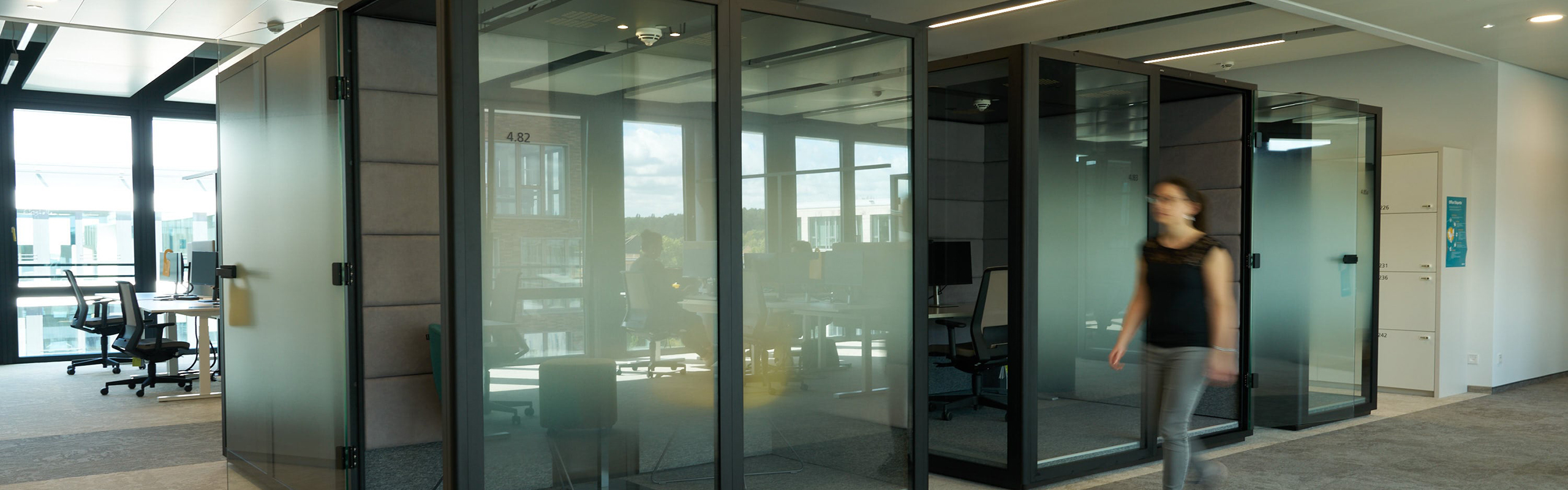
Even when noise levels are within acceptable limits, office noise can be stressful for many employees. Individual solutions and noise protection in the workplace are therefore essential. A well-thought-out office concept that takes room acoustics, zoning and working methods into account from the outset is therefore crucial. Targeted acoustic planning, material selection and a room concept tailored to the needs of employees can effectively reduce background noise – and create an environment in which communication remains possible without disturbing concentration. This can result in a working environment that promotes performance and health. We are happy to support you in this.
Contact us to shape the future of your company together.
Interested in redesigning your office environment? Feel free to contact us to create an office environment that is precisely tailored to the needs of your company and your employees! Contact us to learn more about how we can transform your rental space into an inspiring working environment.
We would be delighted to assist you with your project!