Change Management in Office Design
What is Change Management? (Definition)
Change management refers to the activities and measures used to implement, guide, and support comprehensive changes within an organization. These may include new strategies, structures, systems, processes, or behaviors that need to be introduced. The goal is to ensure a smooth change process and a successful outcome.
What does coneon mean by Office Design?
At coneon, office design refers to the holistic planning and structuring of a work environment—including office spaces, meeting rooms, lounges, cafeterias, kitchens, hallways, and archive areas—with the goal of supporting employees in their tasks in the best possible way. This, in turn, increases satisfaction and productivity. The process begins with the allocation of departments on the floor plan, continues with material and furniture planning, and extends all the way to interior construction and the final office fit-out.
What does Change Management have to do with Office Design?
When it comes to office design, change management plays a crucial role. Whether it involves an office relocation, new office furnishings, or a complete interior renovation, a change process is always involved—one that often poses challenges for both managers and employees. People tend to react critically to change at first. Comments such as “But this is how I’ve always done it” or “I won’t be able to get used to that” are heard frequently. At the same time, everyone wants improvement and has suggestions for change.
In any office redesign process, employees need to be guided and included from the very beginning to ensure the desired enthusiasm and long-term success. Simply aligning a concept with management and pushing it through will rarely work. How coneon implements change management in companies—and how the “depression phase” (see below) can be shortened—is explained in this article.
Change in the World of Work
Many people are afraid of the future. At coneon, we view the ongoing changes in the working world not as a threat but as an opportunity to move forward. Topics such as digitalization, globalization, new technologies, and increased mobility have a direct impact on how we work and reshape the competencies required of employees.
coneon deals daily with the question of how a modern work environment can meet these new requirements and develops solutions for a wide variety of organizations. As experts in office design, we aim to take away your fear of change and guide you step by step through the entire transition process.
veryone Wants Change, but No One Wants to Change – Why?
Change is something positive, but it also involves letting go of something. For many people, giving up an old habit and taking on a new one is difficult. Why is that? Often, people resist change because they focus too much on what they might lose instead of what they stand to gain. coneon encourages you to focus on the goal. Through our office design guidance, we help you minimize the “depression phase” of the change curve—as illustrated in the model below—and navigate the transition smoothly.

conference room before
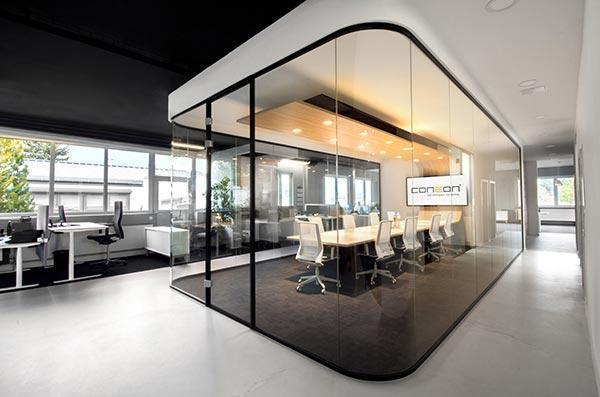
conference room after
Behavioral Patterns in the Change Process
Who hasn’t experienced this? Management introduces a new idea or a new project workflow – and the outcome is predictable: 10% think it’s great, 50% are moderately enthusiastic, and 40% don’t like the idea at all. Every person reacts differently to change and everyone has an opinion about it.
Researchers have identified a typical behavioral pattern that can be applied to almost any change process. The graphic below illustrates how productivity develops over time. Time is the first key factor to consider in this process. The following behavioral stages can typically be observed:
- Denial (“I don’t need this,” “It won’t be implemented anyway”)
- Anger (“Now I have even more work,” “I don’t want this”)
- Bargaining (“If I do this, I want more pay or fewer tasks”)
- Depression (“None of this makes sense,” “I’m fed up”)
- Exploration (“Actually, this is quite useful,” “With some time, I might get used to it”)
- Acceptance (“This new concept was a good idea,” “It works better than I thought”)
Once acceptance sets in, enthusiasm and productivity begin to rise.

Our Change Management Strategy
Whether you choose our THINK services (workplace analysis), DESIGN services (office planning), BUILD services (interior construction), or simply order office furniture from us – our change management strategy extends across our entire service portfolio. Coneon guides you and your employees through every step of the transformation of your working environment.
We start with keynote sessions, town hall meetings, workshops, interviews, and surveys to understand your company in depth and to develop a tailored spatial concept for you. Coneon creates an inspiring vision designed to ease the concerns of employees and decision-makers alike. Throughout the construction and implementation phase, we remain in continuous communication with you. Even after the final handover, we follow up and take your employees’ feedback seriously.

Phases of the Change Process According to John P. Kotter Applied to Office Design with coneon
- Create a Sense of Urgency
To introduce the topic, coneon’s experts deliver keynote sessions on the modern world of work and demonstrate what a contemporary office concept must achieve and why the work environment is crucial for a company’s productivity. Coneon also offers town hall meetings and interviews to build awareness and momentum. - Build a Guiding Coalition
It is important to assemble a strong team of decision-makers from various departments within the organization—such as management, facility management, HR, and IT—to ensure all relevant areas are represented. The works council should also be involved early on and kept well-informed to prevent internal conflicts later in the process.
Through employee surveys and workshops with key decision-makers, coneon works with you to develop an office concept that truly fits your company. At the core of this shared vision is a work environment that enhances people’s lives and demonstrably increases your company’s productivity.. - Communicate the Vision
Once the workplace analysis is complete, our designers create office layouts and compelling visualizations. Coneon presents the vision for your new workspace on-site to spark enthusiasm and reduce concerns about upcoming changes. At this stage, it is essential to inform and motivate employees so they understand the purpose behind the renovation measures. - Remove Obstacles
During an office renovation, various stakeholders with different expectations and interests come together. As a general contractor for workplace environments, coneon ensures transparent communication among decision-makers, trades, architects, and employees to prevent obstacles caused by miscommunication or conflicting ideas. - Generate Short-Term Wins
Employees excited about their new height-adjustable desk, or executives impressed by a redesigned conference room—these are natural short-term wins in any office transformation. Coneon encourages you to celebrate these successes and maintain an optimistic outlook, even while the renovation is still ongoing. - Sustain Momentum and Keep Moving Forward
After moving into a new office, there may still be technical issues or missing finishing touches such as wall art or greenery. Many employees begin to voice concerns at this stage. Do not lose momentum—continue promoting a positive mindset. Coneon manages this phase and ensures that every detail of the office design is carried through to completion. - Anchor the Changes in the (Organizational) Culture
A new work environment often comes with new behaviors or policies. Desk sharing and clean desk policies are well-known cultural practices. New rules regarding meeting room usage or guidelines on noise levels can also feel overwhelming at first. Even after project completion, coneon takes the time to follow up, assess how the new office concept is being adopted, and provide support where needed.

Keynote: Modern Work Environments

Workshops with Key Decision-Makers

Office Planning & 3D Visualization

Lived Corporate Culture
5 Reasons to Choose coneon for Change Management in Office Design
- As an external coach, coneon works closely with both employees and decision-makers, ensuring a comprehensive and unbiased perspective.
- Starting with a detailed analysis and concluding with post-project support, coneon implements changes in a sustainable and long-lasting way.
- coneon understands typical human reactions during change processes, can assess concerns, and helps reduce employees’ fears.
- As a general contractor, coneon ensures transparent communication between all stakeholder groups involved.
- coneon’s experienced team—consisting of project managers, designers, and engineers—supports you from A to Z on your journey toward a modern work environment.
Are you planning a transformation of your workplace but unsure where to start?
Examples of Change Management in the Office
Some of our clients—such as NGK Spark Plug, Century Link, Walter Pilot, and many others—have already benefited from our support starting in the analysis and planning phase. Read more about our projects.