
Execution Planning: When Planning Becomes Reality
Why execution planning is critical to project success
The quality of a project is not determined on the construction site, but in the execution planning phase beforehand.
Once the design and approval planning phases are completed, the stage begins where concepts are transformed into concrete, implementable solutions. Together with all involved planners, materials, technical requirements, and execution details are defined in a way that ensures they function in reality.
Execution planning creates the precise foundation for implementation—and thus becomes one of the key factors for quality, cost control, and adherence to timelines throughout the entire project.
What is execution planning?
Execution planning is an essential component in architecture and encompasses both technical and organizational aspects of a project. All approved concepts and decisions are translated into detailed, binding planning documents. All spaces, built-in elements, and furnishings are precisely defined and developed to ensure clear implementation.
The aim is to define every single element of a construction project so precisely that no room for interpretation remains. Dimensions, materials, technical solutions, and the exact positioning of all components are clearly specified.
Execution planning therefore serves as a central working tool for all project stakeholders. It enables the project to be realized exactly according to defined requirements and forms the basis for a structured and controllable construction process.
A clear example of execution planning is the detailed design of a structural connection. Material layers are precisely defined, dimensions and tolerances are specified, and the connection to adjacent components is technically described.
Only through this level of detail does a design become a concrete, implementable solution that can be executed on site without ambiguity.
Execution planning according to HOAI: Overview of service phase 5
Execution planning according to HOAI corresponds to service phase 5 (LPH 5) and represents one of the most important phases within the entire planning process.
In this phase, previously developed designs are fully refined and planned in detail. All structural and technical requirements are integrated and checked for feasibility. At the same time, close coordination with all planners ensures a consistent overall concept.
Service phase 5 thus forms the direct basis for tendering and awarding construction services as well as for the subsequent construction phase, marking the transition from planning to implementation.

What are the objectives of execution planning?
The main goal of execution planning is to create maximum clarity before construction begins. By working out all details precisely, potential errors can be avoided early on and uncertainties during construction reduced.
A high level of detail also enables efficient structuring of construction processes. In addition, it forms the basis for reliable cost calculations. Clearly defined services allow for precise quotations, significantly reducing the risk of cost deviations for clients.
At the same time, well-thought-out execution planning ensures smooth processes on site and helps prevent delays.
What is included in execution planning?
Execution planning includes all documents and information required for implementing a construction project. At its core are detailed plans and drawings that precisely depict buildings and spaces in floor plans, sections, and elevations. All structural elements such as walls and ceilings are shown, along with connection details.
This is complemented by detailed lists of all components, materials, and even tools required. Detailed and connection drawings, such as wall-to-ceiling junctions, are also part of execution planning.
Another key component is technical building services planning. Mechanical, electrical, and plumbing systems are integrated and coordinated to ensure clear specifications for execution.
Regular communication with all stakeholders is also essential during this phase. Coordination between architects, site managers, and others ensures that all specialist plans are aligned and that potential conflicts are identified and resolved early. Quantity take-offs during execution planning form a crucial basis for tendering and awarding contracts.
Compliance with all legal requirements and standards is fundamental, ensuring the project adheres to building regulations, safety requirements, and energy and environmental laws.
How does execution planning work?
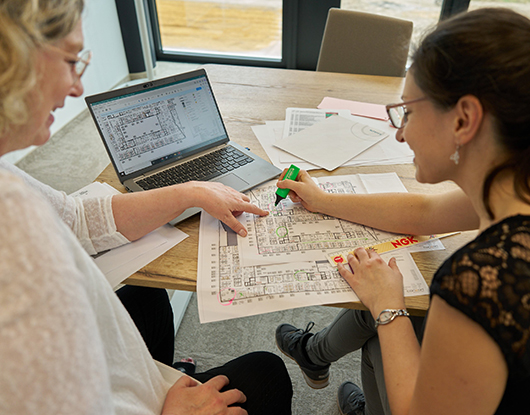
Execution planning builds on the design phase, which is gradually refined and detailed throughout the process.
Through multiple coordination loops, all components and constructions are developed, technical requirements are integrated, and planning content is continuously reviewed. Close collaboration between all parties—especially between architecture and technical disciplines—is essential.
The result is a consistent and contradiction-free plan that can be clearly understood and implemented by all involved.
Architectural execution planning: responsibility and role
Architectural execution planning plays a central coordinating role within the project. Architects are responsible for bringing together requirements related to design, technology, and cost-efficiency.
This involves not only the technical development of a design but also preserving the original design intent during implementation, while ensuring compliance with all relevant standards and regulations.
Architecture thus acts as the link between concept and reality.

Collaboration as a success factor
The quality of execution planning largely depends on collaboration among all stakeholders. Construction projects are complex systems where numerous disciplines interact.
Open and structured communication is essential to avoid misunderstandings and make efficient decisions. Regular coordination, clear responsibilities, and transparent documentation ensure that all participants work on the same information basis and can identify challenges early.
Only in this way can interface issues be avoided and a smooth project process ensured.
At coneon, experts from design and construction work under one roof, eliminating interfaces and enabling faster coordination — resulting in significant time savings.
Cost control and risk management in execution planning
Execution planning is a key lever for the economic management of a construction project. Detailed planning enables more accurate cost calculations and early identification of deviations.
Continuous monitoring of project costs and proactive handling of potential additional costs are essential for staying within budget. Risk management also plays an important role, with potential risks identified, evaluated, and mitigated through appropriate measures.


Quality assurance in execution planning – reporting
Quality assurance is a core component of execution planning. Quality management ensures that all planning content meets defined requirements and standards.
The goal is to achieve a high level of quality already during the planning phase, which then continues into execution. Consistent quality assurance reduces errors, increases efficiency, and significantly contributes to project success.
Shop drawings vs. execution planning: the difference
The terms shop drawings and execution planning are often used interchangeably but differ in function. While execution planning is responsible for overall coordination and planning, shop drawings refer to the detailed elaboration of individual trades by executing companies.
Both types of planning interlock and complement each other to ensure precise and smooth implementation.
Execution planning checklist
A structured execution planning checklist helps systematically verify the quality of planning and avoid errors. It ensures that all dimensions are clearly defined, materials are fully specified, and all interfaces between trades are resolved.
It also verifies that planning documents are complete, consistent, and sufficiently detailed. This systematic control reduces uncertainties and supports a smooth construction process.
Sustainability aspects in execution planning
Sustainability is becoming increasingly important in execution planning. Key decisions made at this stage influence future resource consumption and the lifespan of a building.
The focus lies on selecting environmentally friendly materials, efficient use of energy and resources, and ensuring durability. Well-thought-out execution planning therefore contributes not only to project quality but also to long-term sustainability.
However, sustainability goes beyond ecology alone—it also includes broader ESG considerations in modern work environments.

Why is execution planning so important?
The quality of execution planning has a direct impact on the entire project process. Precise planning ensures clear workflows, reduces errors, and enables reliable cost and schedule management.
In contrast, unclear or incomplete planning documents often lead to delays, additional costs, and coordination issues. Execution planning is therefore a key success factor in project management.
It is the crucial link between design and implementation—translating ideas into concrete, realizable solutions and forming the foundation of a successful construction project.
Careful planning at this stage lays the foundation for quality, efficiency, and economic viability—and thus for the long-term success of a project.
At coneon, we take full responsibility. Our experienced interdisciplinary team of site managers, architects, workplace experts, and fire safety specialists delivers execution planning seamlessly, without interfaces. This saves time and ensures smooth project delivery. We are happy to support you with your project.
FAQ – Frequently asked questions about execution planning
The following questions and answers provide a concise overview of key aspects of implementation planning in the context of modern working environments.
Execution planning (service phase 5) is the detailed planning of a construction project that includes all information required for implementation.
It includes floor plans, sections, detail drawings, and specifications for materials, dimensions, and technical solutions.
Execution planning is usually carried out by architects, specialist planners, or engineers.
Design planning defines the concept, while execution planning translates it into concrete details.
The duration depends on the scope and complexity of the project.

Request a consultation now!
Let’s shape the future of your office work together – contact us for a personalised consultation and joint planning.